DJ Skills: 10 Essential Skills Every DJ Must Master

February 17, 2026
DJ skills are the technical, musical, and performance abilities a DJ uses to mix tracks smoothly, control sound levels, and engage a live audience.
The most important DJ skills include beatmatching, phrasing, EQ control, track selection, gain staging, crowd reading, and music library management.
In this guide, you will learn the 10 essential DJ skills every beginner should master, the equipment needed, and a roadmap to build your abilities as a skilled DJ.

What Are DJ Skills?
DJ skills form the foundation for a DJ set, combining technical proficiency in mixing with an understanding of crowd dynamics.
They also include music curation and track selection across different genres, tailoring sets for various venues and scenarios.
Such skills allow aspiring DJs to hone a unique persona and perform a distinctive style of music that sets them apart from other DJs.
Essential DJ Skills
Essential DJ skills include aligning track tempos for beatmatching, using phrasing and EQ to shape transitions, and managing diverse music libraries.
Additional skills DJs need to learn include:
- Managing the volume of tracks using gain control.
- Preparing the next track in the mix with cueing tools.
- Applying effects and samples to sets to bring additional texture and atmosphere.
- Using advanced features for techniques such as looping and scratching.
- Learning how to read the crowd to manage energy levels and build anticipation.
- Building a DJ brand for promotional purposes to reach new audiences.
- Sharing mixes and networking with other DJs to discover new artists and land more gigs.
Some DJs also explore music production by incorporating dedicated live-performance hardware into their DJ setups.
Learn more: Is DJing hard?
DJ Equipment Needed to Practice DJ Skills
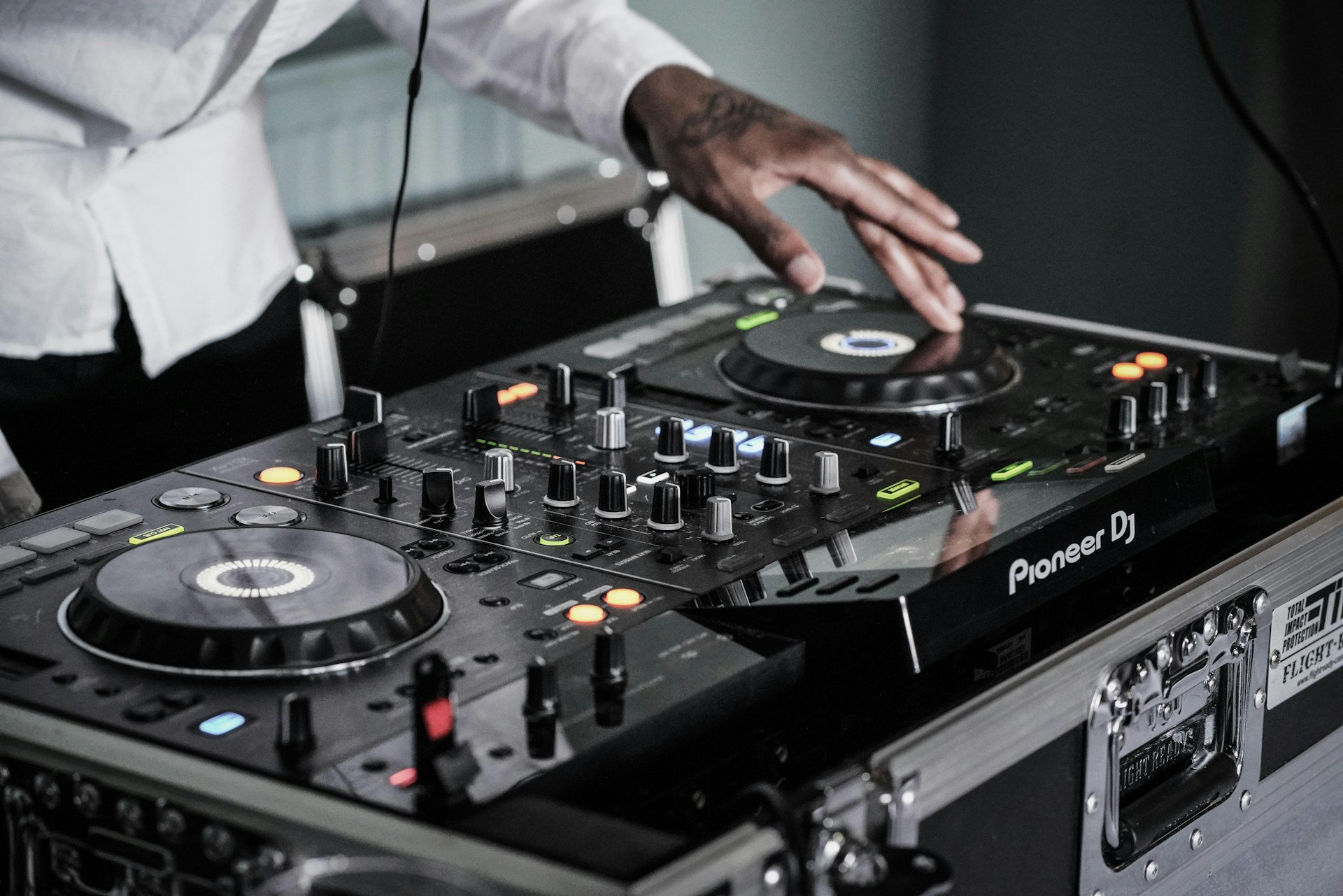
In order to learn DJ skills, you’ll need to invest in the core DJ equipment needed to mix your music library in a set, including:
- A DJ controller for performing mixes, including beatmatching, EQing, and other core techniques.
- A laptop or computer to run your software and store your music library.
- DJ software to perform your DJ sets and connect with the controller.
- A pair of DJ headphones to monitor incoming tracks before dropping them into the mix.
- A pair of DJ speakers to play the music on the dance floor.
If you’re considering DJing with physical media, such as CDs and vinyl, you’ll need to invest in CDJs and turntables for these formats.
You’ll also need a selection of DJ accessories, including cables, USB drives, and a microphone for wedding and mobile DJing.
10 Essential DJ Skills Every DJ Must Master
Regardless of your goals and preferred style of music as a DJ, the essential skills you’ll need to master remain fundamentally the same.
These 10 essential DJ skills cover the technical, creative, and professional abilities required to perform live DJ sets and build a sustainable DJ career.
1. Understand Basic Music Theory
The foundational music theory for a DJ set includes concepts such as tempo and beats per minute, musical key, and song structure.
Knowing how to find the BPM of a song allows for accurate beatmatching, quickly identifying other tracks with a similar tempo.
Likewise, an understanding of song structure, such as intros, outros, choruses, and verses, aligns with DJ phrasing.
While you don’t need in-depth knowledge of music theory, a familiarity with these concepts lays the foundation for the essential skills.
2. Build A Comprehensive Music Collection
A comprehensive music library lays the foundation for DJ sets, establishing the genres, mood, and energy levels of your performance.
Building eclectic DJ playlists is especially important for open-format DJs, who blend multiple genres such as hip-hop, house, and pop.
Many DJs purchase individual tracks from platforms like Beatport or collect physical media, such as CDs and vinyl records.
Alternatively, you can sign up for a DJ music pool for your genre and budget, instantly accessing thousands of ready-to-use tracks.
Further reading: Digital music management masterclass.
3. Master DJ Software & Hardware
With a broad selection of DJ software for PC and Mac, it’s important to choose the platform that best matches your goals.
Here’s an overview of popular DJ software and hardware options, from club DJ gear to beginner-friendly options:
| Brand | Platform | Best for | Skill focus |
|---|---|---|---|
| Pioneer DJ | rekordbox + CDJs / controllers/mixers | Club-standard setups & pro workflows | Beatmatching, performance on club gear |
| Serato | Serato DJ Pro + compatible controllers | Scratch DJs & open-format performance | Scratching, cue juggling, live performance |
| Native Instruments | Traktor Pro + Kontrol series | Creative & hybrid digital DJs | Looping, remixing, FX control |
| Algoriddim | djay Pro (Mac/iOS/Windows/Android) | Beginner-friendly mobile/desktop DJing | Easy mixing, automix, streaming integration |
| Virtual DJ | VirtualDJ | All-in-one versatile DJ software | Mixing basics, sampling, video DJing |
4. Learn Beat Matching
Once you’ve set up your equipment and built a library of tracks to mix with, you’re ready to start mixing with beatmatching.
Learning to beatmatch manually takes practice, though many DJ applications also offer sync features to help beginners.
An excellent DJ tip is to use the kick drums from each track as key points for dropping the incoming track over the outgoing track.
If you’re mixing with vinyl records, you’ll need to manually match the tempo of each track using the turntable’s pitch control.
While this is a more challenging skill to learn, it will give you a deeper understanding of the process and is essential for scratch DJing.
5. Hone Gain Control & Mixing Techniques
With your tracks correctly aligned through beatmatching, you’re now ready to begin blending them over the sound system.
This involves a combination of gain control to manage volume levels, paired with beginner DJ mixing techniques like:
- EQ transitions: Basic transitions use your hardware’s EQ, allowing you to control the low-, mid-, and high-frequency elements of a song when blending them together.
- Phrasing: The beginnings of choruses, verses, and other song structural elements can serve as cue points and help align your mixes.
- Filtering: The best DJ mixers feature robust filter knobs for high- and low-pass filtering, which creates a sweeping effect for more dynamic transitions.
As you gain confidence performing these easier mixing techniques, experiment with new artists and songs to expand your repertoire.
6. Develop A Personal Brand & Performance Style
For those considering building a professional career, establishing an identifiable personal DJ brand is another important skill.
Branding begins with a distinctive name and visual elements, such as logos, that can be used on your DJ website and social media pages.
This branding is vital for establishing a clear online presence and enhancing discoverability by potential clients and fans.
If you’re struggling to define your brand, check out the most influential DJs of all time and see how they present their personas.
7. Experiment With Effects & Sampling
As the core techniques become second nature, you can elevate your mixes by adding effects and triggering samples over the music.
You can build a library of DJ sound effects from downloaded packs, and record your own sounds using your phone or a dedicated microphone.
Packs of DJ samples are also available and can be triggered instantly using performance pads on certain hardware.
If you’re into music production, you can integrate high-end sampling tools, such as the Roland TR-1000, into your DJ setup.
8. Explore Advanced Techniques Like Scratching & Looping
While the core techniques provide leeway for creative mixing, additional advanced skills can significantly elevate your performances.
For genres like hip-hop and turntablism-based styles, you can learn to scratch by applying techniques like beat juggling and other scratching methods.
Looping is another high-level technique used by professionals, extending the playtime of certain tracks and providing additional space for transitions.
You can also explore using a DJ key chart for harmonic mixing, taking transitions beyond percussion, and incorporating vocals and instruments.
9. Record & Share DJ Mixes & Live Remixes
Feedback is essential for improving as a DJ, and recording your DJ set lets you share it with friends and other DJs.
There are several ways you can share a DJ set online, from uploading to YouTube or using dedicated platforms like Mixcloud.
Be aware that copyright may be an issue on some platforms, resulting in copyright strikes, notably on SoundCloud and YouTube.
10. Build Your DJ Career With Networking
Another essential soft skill for aspiring DJs is networking, which helps you promote your music and build a career.
Networking can involve in-person conversations with promoters for local venues, or through online communities and forums.
Your networking strategy should also incorporate social media, whether sharing services for wedding DJ gigs or engaging with fans.
As your network expands, you’ll discover new sources of excellent music, line up more gigs, and learn how to perform better mixes.
Find out more: How do DJs find new music?
Common Challenges When Learning DJ Skills
Learning the art of DJing can be challenging for newcomers, so here are some common mistakes and how you can avoid them:
Lack of familiarity with equipment
Solution: Using DJ software for beginners, testing your hardware, and performing sound checks will help you become more familiar with how the equipment works.
Performance anxiety
Solution: Breathing exercises, thorough set preparation, and DJing sober are recommended for those suffering from performance anxiety.
Weak understanding of tempo and key
Solution: Learning the theory around tempo and key can be accomplished through online tutorials, while the best DJ equipment offers dedicated tools for these concepts.
Best Gear and Resources for Learning DJ Skills
Whether you’re learning how to mix songs for dance music or open-format parties, there are plenty of resources to help build your skills.
Let’s explore some of the DJ software and tools, as well as handy learning resources you can use to streamline the learning process:
DJ Software & Tools
Learning how to DJ on a budget is easy with free-to-use mixing software and trial versions of professional-level software.
You can also use dedicated DJ stem separation tools for creative mixing, along with key-analysis tools for harmonic mixing.
Learning Resources
Learning resources range from in-depth YouTube video tutorials for DJs to structured courses on platforms like Coursera.
You can also join DJ forums and online communities, engaging with other DJs to get advice on any particular pain points you’re experiencing.
DJ Skills Roadmap for Beginners
To help you get started DJing, we’ve created this practical roadmap for beginners to reference as part of their learning journey.
This 4-week DJ skills roadmap shows exactly what beginners should practice each week to build foundational DJ skills.
| Week | Focus skill | Practice goal |
|---|---|---|
| Week 1 | Basic beatmatching & track structure | Learn to identify intros, breakdowns, drops, and outros, and manually match tempos between two tracks without relying fully on sync. |
| Week 2 | Song selection & basic transitions | Create a short 15–20 minute practice set and smoothly transition between at least 6 tracks using simple fades and EQ. |
| Week 3 | EQ control & phrasing | Perform clean transitions by cutting and blending lows, mids, and highs at the correct phrase points (every 8 or 16 bars). |
| Week 4 | Set building & crowd flow | Plan and record a 30-minute beginner DJ mix that starts low-energy, builds gradually, and maintains consistent energy without abrupt changes. |
How Long Does It Take to Learn DJ Skills?
While each individual’s DJ journey is different, learning how to DJ typically takes between a few weeks and several years, depending on skill levels.
Let’s break down the average time it takes to learn DJing based on common categories:
- Beginner hobbyist: Learning the fundamentals of DJing can take between 1 and 2 months, covering hardware mechanics, basic blending, and software features.
- Mobile DJ: For mobile DJing with an open-format approach, the learning timeline ranges from 3 to 6 months, covering more complex technical knowledge and reading the crowd.
- Aspiring club DJ: If you’re hoping to become a club DJ, expect to spend between 6 months and 2 years mastering precise mixing while building a distinctive persona.
Professional DJs often expand their skills into music production, incorporating their own tracks into their DJ sets.
Related reading: The 10 best club DJs.
DJ Skills FAQs: Common Questions Answered
In case you still have any queries about DJ skills, here are some answers to frequently asked questions:
Is DJing a hard skill?
DJing is relatively easy to master the basics, but it has a steep learning curve to master advanced technical knowledge and skills.
Hobbyists can pick up the core skills in a few days, while professional DJs take years to develop high-level techniques.
What do beginner DJs need?
Beginner DJs need the following to learn DJing skills:
- DJ controller
- headphones
- DJ software
- Selection of tracks
- Basic music theory knowledge
Can DJing be self-taught?
Yes, DJing can be self-taught, with most DJs using online resources and learning the basic skills from DJ friends.
By combining online tutorials with regular practice sessions, new DJs can learn the core skills and develop a unique, personal style.
Summary
Learning the core DJ skills is essential for anyone who wants to mix music confidently and perform engaging DJ sets.
From beatmatching and phrasing to EQ control, track selection, and reading the crowd, these skills form the foundation of every successful DJ performance.
With consistent practice, the right equipment, and a growing music library, you can steadily develop your abilities and build your own distinctive DJ style.
Not a member ?
Join Today for Unlimited Music Downloads. Visit zipdj.com for more information.